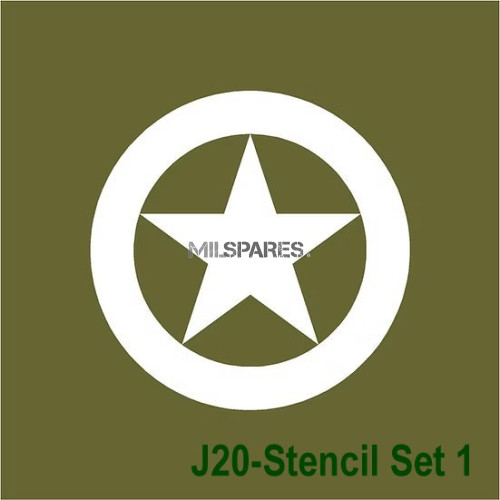
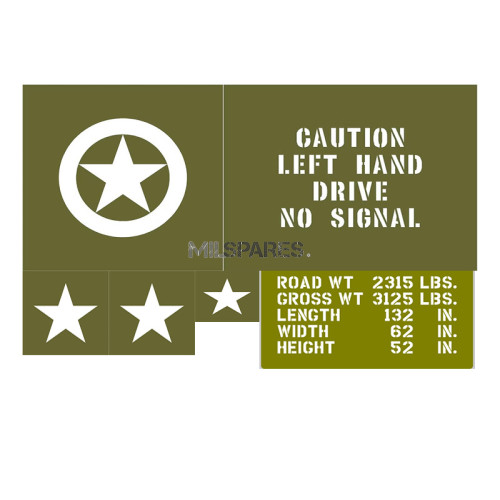
Normandy Invasion Star. Kit includes:
1 set consisting of
• 1 x 25 inch bonnet star with unbroken circle
• 2 x 6 inch side star
• 1 x 3 inch bumper star
• 1 x shipping stencil
• 1 x 2 inch NO SIGNALS
• 1 x 2 inch CAUTION LEFT HAND DRIVE
Solid Circle: Used on upper surfaces (hoods, engine decks) for air recognition
The "Normandy invasion star" refers to the white star insignia painted on Allied vehicles during the D-Day invasion, Operation Overlord,. Its purpose was to identify vehicles as "friendly" from the air, and for the Normandy invasion, a white circle was often added to a plain white star, with variations like a "lazy circle" appearing due to the rapid stenciling process. The star was a quick, airborne recognition symbol to distinguish Allied vehicles from German ones. It was initially a plain white star, but a variation with a white circle was added for the Normandy invasion. Many stars were hastily stencilled, resulting in a broken or "lazy" circle. More notes below:
Instructions for installation - Please click on the link below provided by our friends at Ron Fitzpatrick Jeep Parts, USA. Ron has kindly given us permission to use this video. Ron you are a STAR!
"Do it yourself, how to install stencils on your vehicle, Team G503, Willys MB Ford GPW"
The Invasion Star Explained
Purpose: To quickly identify Allied vehicles from the air, preventing friendly fire from planes, especially crucial during large operations like the Normandy landings.
Design: A white star, often surrounded by a circle (the "invasion star"), applied with stencils or even cardboard, leading to imperfect, hand-painted looks.
Variations:
Solid Circle: Used on upper surfaces (hoods, engine decks) for air recognition.
Broken Circle: Also used on vertical surfaces (fenders, doors) to distinguish them, sometimes indicating American origin.
Star Direction: A star pointing away from the driver indicated Commonwealth (Canadian, Australian) vehicles, while one pointing towards the driver was American.
"Broken" Look: Real-world application was messy and hasty, resulting in stars with gaps, showing underlying paint, or uneven edges, a look often replicated by restorers for authenticity.